
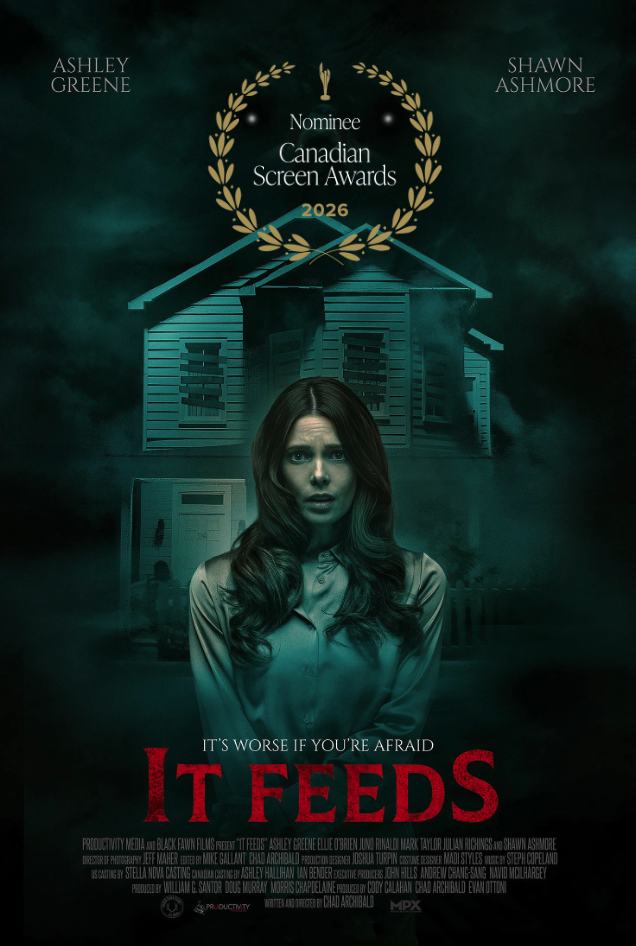
THE ART OF FILM SCORING - a conversation with CSA nominated composer Steph Copeland
As a lead up to the 2026 Canadian Screen Awards, Core is shining the spotlight on some of our nominated composers with a series we call, "THE ART OF FILM SCORING”, where we interview, probe and prompt composers to talk about their process.
Martin Mull once said, “Talking about music is like dancing about architecture”. So hard is it to talk about music in words, and yet composer and filmmaker must use their words to find the inner essence of the story in music. In the coming weeks, we’ll be talking about talking about music - starting with composer STEPH COPELAND and her CSA nominated score for IT FEEDS.
A. Hi Steph, congrats on your CSA nomination. Can you talk a bit about your relationship with director Chad Archibald?
S. Creating the score for It Feeds was part of a long collaborative relationship between Chad and I. Over the years, we've worked on eleven Black Fawn productions together, five of those with Chad Archibald directing, so we really have a shorthand. There’s a lot of trust, and we can move pretty intuitively. A big part of our creative collaboration for It Feeds was finding ways to pay homage to classic horror while building an otherworldly sonic identity, especially when we delve into uncharted metaphysical realms in the story.
We approached the score as three distinct worlds, each with its own palette, with the goal of balancing the weight of trauma and grief with the language of classic horror.
A. What were those 3 worlds, and how would you describe them?
S. Chad and I broke it down like this…
Under Hypnosis: When Cynthia puts her patients into a hypnotic state to reveal their hidden trauma, we added heavy atmosphere meant to feel like a thick fog in the patients minds, weighing them down. I had the pleasure of working with the incredible Will Lamoureux who provided ultra processed electric violin for sweeps and bends as signals that emerge from the "fog". As Cynthia traverses the minds of her patients using her clairvoyant ability, we hear ethereal voices meant to symbolize her guiding presence, leading the patient to safety. Here’s an example:
https://on.soundcloud.com/GYil82NWSIOHjYNU9d
The Real World: Here we used acoustic instruments to anchor us to a feeling of home and safety, then pulling the rug out from underneath that feeling. Violin, bass and piano along with wooden instrument textures, percussive hits and noisy acoustic pulses in combo with clustered brass swells and more traditional orchestra for classic horror. It’s in the real world where the threat comes to exist...
https://on.soundcloud.com/HPfrN4EQ301MaWaygU
The Entities Mind: We wanted to create a world that felt organic yet foreign, and hollow but also claustrophobic, so we used the Lyra 8 (organismic drone synth) because what else would you use for the sound inside of a demon’s mind? Combined with bending processed brass and distorted traditional percussion to give the feeling that this entity is both timeless and ancient:
https://on.soundcloud.com/tTu85kMeTGwWjOQvXI
A. How do you know when you’ve found the central theme to the story in music? How do you know when that magic has been unlocked?
S. I think a good sign is when you can carry the main melody over other pivotal moments in the film and you're still feeling connected to the character's journey. Sometimes I aim my main theme at some hidden subtext in the story that might not be evident on the surface. If the music can carry a bit of that undercurrent, that usually signals I've found something special to run with.
A. A lot of weight is put on the idea of musical “themes” but themes and motives aren’t always just a catchy melody are they?
S. That’s right, a musical theme or “motif” can be a sequence of intervals, or it can be a rhythm, a texture, an harmonic progression, or even just a single percussive sound. A motif can be any element (subtle or overt) that attaches itself to a particular idea in the narrative.
A. What’s your favourite part of the process? Is it when you sit down and find the first golden nuggets of the score, or is it in the development and recording, or is it when it’s all over and you see everything synced to picture, properly mixed with all of the other sound elements?
S. A little bit of each, for sure. Getting started is incredibly satisfying because you have a blank canvas with a focussed mission, but you get to dig around in the crate for sounds and melodies. The first spark of an idea always gives a dose of instant gratification. Once we get further into the themes and ideas have had a chance to soak in for a while, bringing in session players to put that top layer sheen on the cue, breathes new life and jump starts the whole scoring process. That's when things get really exciting and momentum builds. When it all comes together in the final mix and you can stand back and appreciate the story as one ubiquitous form, it's incredibly rewarding.