
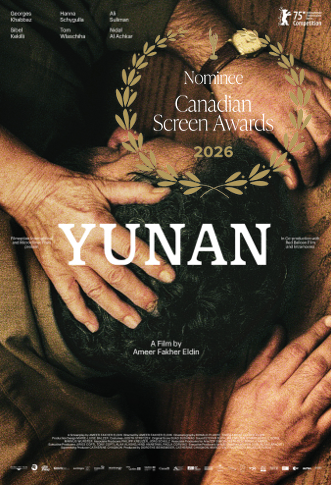
THE ART OF FILM SCORING - a conversation with CSA nominated composer Suad Bushnaq
As a lead up to the 2026 Canadian Screen Awards, Core is shining the spotlight on some of our nominated composers with a series we call, "THE ART OF FILM SCORING”, where we interview, probe and prompt composers to talk about their process - this week composer SUAD BUSHNAQ talks about her CSA nominated score for YUNAN.
A. Hi Suad, congrats on your CSA nomination. Can you give us some background on this film? Who made it, and where has it shown?
A. YUNAN is a Canadian co-production, produced by Catherine Chagnon and directed by Ameer Fakher Eldin (The Stranger). It premiered last year in the Official Competition at the Berlin International Film Festival and was nominated there for Best Film. I’m so excited to attend the Canadian Screen Awards again, this year representing YUNAN alongside fellow YUNAN nominee Ronald Plante (Achievement in Cinematography).
A. You've had a few CSA nominations in the past, haven't you?
S. It’s my 5th CSA nomination. I was nominated three times for Queen Tut in 2024 (Original Score and Songs), for Jasmine Road in 2022 (Original Score, and I’ve had a few other wins and nominations from other institutions, including from the Hollywood Music in Media Awards and the Canadian Screen Music Awards. It’s not all about the awards, but it is exciting to go to these things and the recognition means a lot when you have been working long months on a score. As the great Catherine O'Hara said in Schitts Creek (in her Moira Rose accent): My favourite season is awards season!
A. Tell me more about Berlinale last year, was that your first time?
S. That was my first time attending Berlinale, and to attend as the composer of an important film made all the difference. From the reception at the Canadian Embassy where Yunan was celebrated as Canada's biggest film that year, to the red carpet glam, to the standing ovation at the premiere, it was all so special. But the one thing I will never forget is how Tricia Tuttle, director of Berlinale, came up to me after the premiere, shook my hand and said, it is our honour to have your music play at Berlinale. This, for me, is something I will never forget my entire life.
A. You're representing Canada well. You should be proud.
S. I am!
A. I've seen some nice write-ups in the trades.
S. What can I say? [blushingly]. The Hollywood Reporter described it as “A soulful Orchestral Score”, Screen Daily described it as an “evocative soundtrack”, and Deadline said, “Suad Bushnaq’s minor-key score…most effectively communicates the protagonist's mournful state of exile”. With all humility, I hope I’ve memorized those quotes correctly  .
.
Scoring the music for Yunan was a true labour of love over a year and a half, shaped through deep creative conversations with the director, Ameer, live scoring sessions streamed between Toronto and Berlin where I would connect him to my logic session through headphones over the cloud, and I think that love finds itself onscreen (or should I say, “in-speaker”?).
I consider it a huge privilege to have been called up to compose, orchestrate, and later record and conduct in Montréal for this film. I had an extraordinary group of musicians and vocalists to work with, and I must thank the wonderful Amy Andersson for her incredible conducting coaching that allowed me to stand confidently in front of an orchestra and conduct my own music for the first time.
A. A basic synopsis of the film will accompany this article, but can we talk a bit about the main character’s journey and how that journey winds itself into the score?
S. Munir, in his exile, has lost hope for life. And now on top of that, his mother doesn't remember him anymore due to advancing Alzheimer's. The existential question is, who are we if our own mothers cannot remember us? This for me was the key that opened up the score because of a personal relationship I have with this disease through my own father. The score had biblical undertones that reflect this journey..after-all, the word Yunan means Jonah, the biblical character who was swallowed by the whale in the sea, and it serves as a metaphor for Munir who is swallowed in his own despair before finding rebirth. But the score also reflected the concept of fragmented, distorted memory which happens when one is in exile… where we miss a past that might not have existed and develop nostalgia for a time or place we don't know. There's a word for that, it's called anemoia, and this happens when one feels uprooted from their home and family. This is what Munir was going through, and I am happy that the score was able to reflect his state of mind during the entirety of the film.
Here's a quick video clip of some of the music from Yunan, that I think really captures Munir's feeling of anemoia.
A. Beautiful, sad and evocative. Thank you Suad. Many congratulations again on your Canadian Screen Award nomination and for all of the success YUNAN has seen so far.
S. Thank you for having me! It's always a pleasure to talk about the Yunan journey; it was incredible.